12 Sideboard Styling Ideas for a Polished Dining Room

A sideboard is the hardest-working wall in a dining room: it stores the good dishes, catches serving platters mid-meal, and holds the one surface guests actually look at while they eat. Styled well, it makes the whole room feel finished; styled badly, it becomes a landing strip for mail, keys, and chargers. The sideboard styling ideas below treat it as both display and workstation, pairing every look with the measurement that makes it work, from mirror width to lamp height to how much surface to leave empty.
Work top-down: wall first, tall pieces second, small objects last. Most dining sideboards run 54 to 72 inches long, 30 to 36 inches high, and 16 to 20 inches deep, and the proportions below assume that range. Pick two or three of these sideboard styling ideas to start; a polished top is an edited one, and you can rotate the rest in as the room evolves.
1. Anchor the Wall With a Round Mirror

Start above the surface, because the wall piece decides everything below it. A round mirror softens the sideboard's long straight lines and bounces window light and candlelight back across the table. Size it at roughly two-thirds the cabinet's width, so a 60-inch sideboard wants a mirror about 36 to 42 inches across, and hang the bottom edge 6 to 10 inches above the top so the two read as one composition. Expect $120 to $300 for a framed mirror in that size, in aged brass, black metal, or pale oak. Browse real proportions in the sideboard photos on Houzz before drilling, and match the frame finish to one metal already in the room, such as the chandelier or cabinet hardware.
2. Let One Oversized Artwork Set the Palette

One large framed print does the color work for the entire display. Hang a single piece 40 to 48 inches wide over a standard sideboard, again about two-thirds the cabinet width, with its center near 57 inches from the floor. Then pull exactly two or three colors from the artwork down into the objects below it: a navy vase for the painting's blue, a rust bowl for its clay tone, a brass lamp for its warm highlight. Large framed prints run $120 to $300, or under $80 for a downloaded file printed and framed locally. Keeping the palette borrowed rather than invented is what makes the top look collected instead of matched, and our oversized wall art guide covers sizing art for the wall space around it.
3. Add Paired Buffet Lamps for Evening Glow

Buffet lamps are the tall, slim lamps designed for exactly this surface, and a matching pair is the fastest route to a formal, polished finish. Choose lamps 28 to 32 inches tall with narrow bases, around 5 inches across, so they add height without eating serving space, and place one at each end with the shade tops just below the top edge of the mirror or art. A pair in aged brass, ceramic, or turned wood runs $90 to $220, with linen shades keeping the light soft at seated eye level. Use 2700 to 3000 Kelvin bulbs on a dimmer if you can. This is the lighting layer our dining lighting ideas build on, because overhead chandeliers alone leave the room's edges in shadow.
4. Build Height in Threes: Tall, Medium, Low

When a sideboard top looks flat, the problem is usually a single height repeated. Group objects in threes arranged as a triangle: one tall piece at the back, a lamp or a vase of branches at 24 to 36 inches; one medium piece in the middle, a bowl, sculpture, or framed photo at 10 to 14 inches; and one low piece in front, a stack of two or three books or a small lidded box at 3 to 5 inches. One or two of these triangles is enough on a 60-inch top. Odd numbers force the eye to travel, which reads as intentional rather than lined up. Most households can build the first triangle from things already owned; budget $30 to $80 only if you need the tall vase to anchor it.
5. Lean and Layer Art Instead of Hanging Everything

Leaning art is the renter-friendly version of the gallery look, and it reads more relaxed in a dining room that already has a formal table. Stand one large framed piece, 30 to 40 inches wide, flat against the wall at the back of the top, then overlap a second, smaller frame in front of it, offset by about a third and shifted to one side. Add felt bumpers behind both frames and a dab of museum putty under the front one so nothing slides when the cabinet doors close. Keep the pair within the middle two-thirds of the sideboard and balance the ends with a lamp and a low bowl. Frames you already own cost nothing here; thrifted frames run $10 to $25 each, which makes this among the cheapest sideboard styling ideas to try first.
6. Corral a Drinks Tray at One End

A sideboard earns its keep during dinner parties, and a tray turns one end into a self-serve drinks station without scattering bottles across the top. Choose a tray 18 to 24 inches long, about a third of a standard sideboard, with a raised lip and felt or leather lining to protect the wood from rings and heat. Style it tightly: two or three bottles or a decanter, four to six glasses, a small ice bucket, and a folded linen towel, with backup bottles stored inside the cabinet below. Trays in wood, marble, or aged metal run $35 to $90. The grouping logic is the same one behind good bar cart styling: contain everything in one footprint, and the whole surface stays calm even mid-party.
7. Stack Books and Ceramics for a Collected Layer

Books and handmade ceramics give a dining sideboard the layered, lived-in quality that new accessories cannot fake. Build one or two short stacks of two or three large books, spines or covers in the room's palette, and top one stack with a small ceramic bowl or vessel to add the medium height. Balance the stacks with a taller handmade vase, 12 to 16 inches, at the opposite end. Mix finishes deliberately: matte stoneware against a glossy glaze, rough clay against smooth glass. Secondhand books run $5 to $15 each and studio pottery $25 to $70 a piece, so a full layer lands around $60 to $150. Dust the stacks weekly and keep red wine glasses off the books; one ring on a cloth cover is permanent.
8. Bring Height and Life With Branches and Greenery

Every polished sideboard needs one living element, and branches do it with the least upkeep. Fill a vase 12 to 18 inches tall with olive, eucalyptus, or bare seasonal branches cut to 30 to 42 inches, so the arrangement rises well above the cabinet and silhouettes against the art or mirror behind it. Place it at one end only, and balance it with a low, wide bowl at the other. Fresh branches cost $10 to $20 a bunch and last one to two weeks; good faux stems run $25 to $45 and last years. Always use a waterproof liner or saucer under the vase and check for drips after watering or refreshing stems, because a water ring on a wood top is the most common way these sideboard styling ideas damage the furniture they decorate.
9. Keep the Center Clear as a Serving Zone
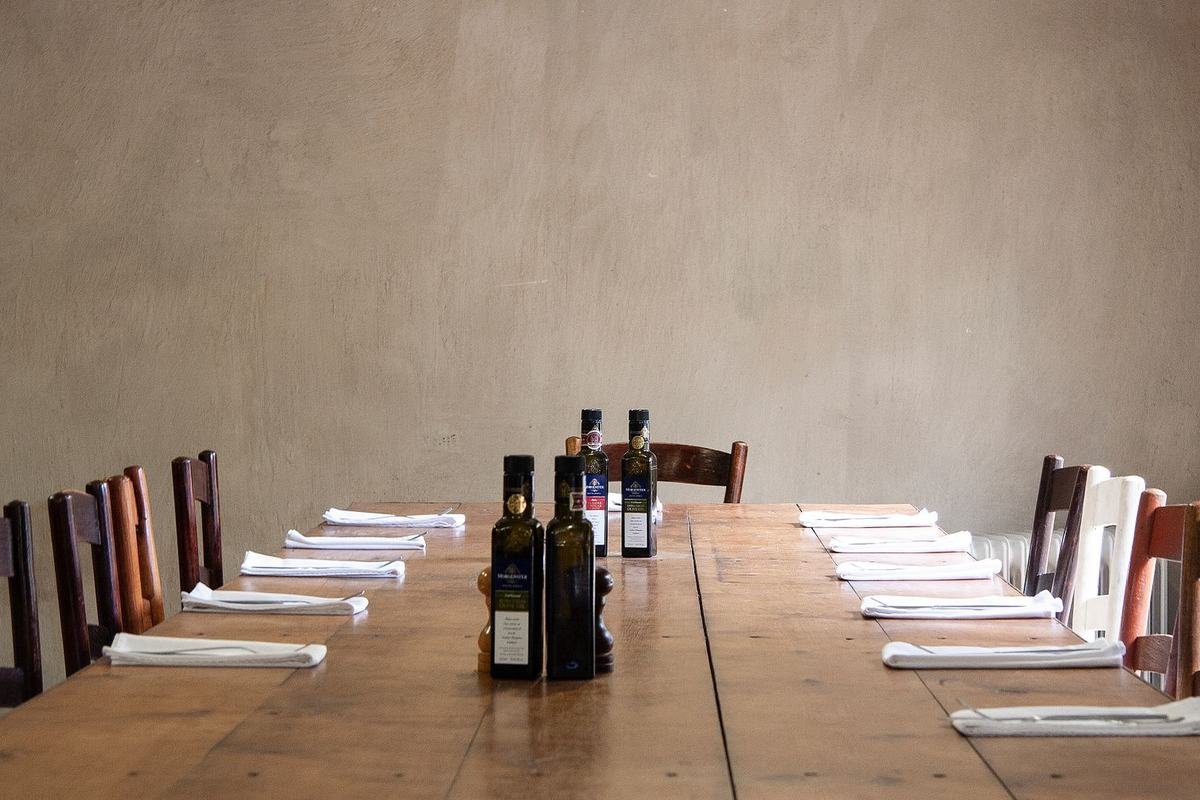
The difference between a styled sideboard and a useful one is a disciplined empty middle. Push decor to the two ends and keep the center 24 to 30 inches of the top completely clear, so platters, a tureen, or a carving board can land there without a reshuffle mid-meal. Stylists aim for 60 to 70 percent of the whole surface empty, and the serving zone is where most of that space should live. Protect the finish inside the zone with a linen runner, $20 to $40, or two cork or slate trivets, $15 to $30, kept in the top drawer. Before guests arrive, do the platter test: set your largest serving dish, usually 16 to 18 inches, in the center. If it fits without moving anything, the styling is done.
10. Build a Gallery Wall and Keep the Top Quiet

A gallery wall lets a plain dining room gain personality while the sideboard itself stays almost bare. Plan a grouping roughly as wide as the cabinet, with the bottom row hanging 6 to 8 inches above the top and 2 to 3 inches between frames. Mix five to seven pieces, landscapes, abstracts, and one or two personal photographs, in frames that share a finish family, such as black with oak or brass with walnut. Because the wall is busy, style the surface with restraint: one lamp, one low bowl, one medium vase. A set of frames runs $60 to $160, and renters can hang the lighter pieces on removable strips rated for their weight. Our gallery wall ideas walk through layout templates that transfer directly above a sideboard.
11. Edit a Small Sideboard Down to Three Pieces

A compact sideboard, 36 to 48 inches long, fails when it is styled like a big one. Give it exactly three pieces: one vertical element, a slim lamp or a tall narrow vase at one end; one horizontal element, a low tray or a single stack of two books; and one soft element, a small plant or a bowl of fruit in the middle. Leave the rest of the top, often 70 percent of it, empty, and hang a mirror or print slightly narrower than the cabinet so the proportions look deliberate. Wall sconces, plug-in models from $60 to $120, add light without spending surface space. The whole edit can cost under $100 using pieces moved from other rooms, which is why this is the most forgiving of all sideboard styling ideas for apartments and narrow dining rooms.
12. Tie It to the Room With Rug, Color, and Texture

A sideboard looks polished when it visibly belongs to the room around it, and belonging is built from repeats. Repeat the cabinet's accent color at least twice more, in dining chair upholstery, curtain trim, or the art across the room, and repeat one texture, linen, cane, rattan, or aged brass, at least twice on the top itself. Underfoot, size the rug so the sideboard's front legs and the pulled-out chairs all stay on it, usually an 8 by 10 foot rug under a six-person table, which our dining room rug sizing guide works through in detail. Rugs in that size run $200 to $600 in wool or washable flatweave. Finish with a two-minute step-back check from the doorway: if the eye lands on the sideboard first and the table second, the room is balanced.
Frequently Asked Questions
How much of a sideboard top should be left empty? Aim for 60 to 70 percent clear. Negative space is what separates a styled surface from a storage surface: it shows the cabinet's finish, lets each object read individually, and leaves room for serving dishes during meals. If the top starts to feel crowded, remove one item from each group rather than rearranging everything; editing down almost always fixes the look faster than adding a unifying piece.
How wide should a mirror or artwork be above a sideboard? About two-thirds the width of the cabinet is the reliable proportion, so a 60-inch sideboard suits a mirror or artwork roughly 36 to 44 inches wide, hung with its bottom edge 6 to 10 inches above the surface. Much narrower and the wall piece looks lost; much wider and it overwhelms the furniture. Pairs of smaller pieces should span the same total width, including the gaps between frames.
Should buffet lamps on a sideboard match? A matching pair is the right call for a formal, symmetrical dining room, and it gives even, flattering light at both ends of the table's eyeline. It is not a rule, though: a single lamp balanced by a tall vase or branch arrangement at the other end creates a relaxed asymmetry that suits modern and organic rooms. Either way, keep total lamp height between 28 and 32 inches so the shades do not block the artwork or mirror behind them.
How do I style a sideboard without spending much? Start at zero cost: clear the top completely, then shop your own home for one tall vase, one stack of books, and one bowl, and arrange them as a single triangle at one end. Lean a framed print you already own instead of hanging new art. After that, the highest-impact buys are a linen runner at $20 to $40 to define the serving zone and a tray at $35 to $60 to contain bottles or candles. Most polished sideboards are edited, not expensive.